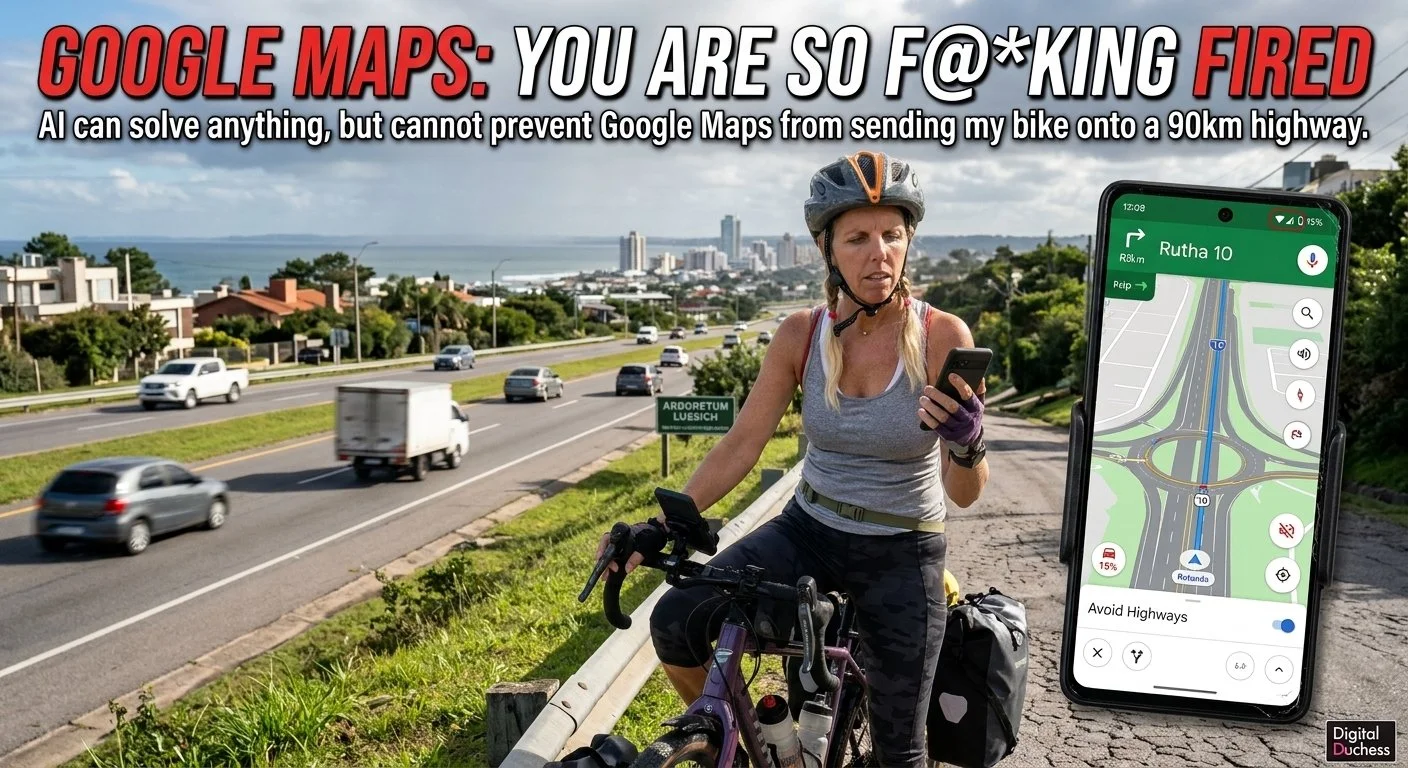
Confused and lost, hopeing to avoid danger and get home before my phone dies
Since my arrival in Uruguay, it seems like more days than not have been cloudy and rainy. This is a stark contrast to the climate I’ve lived in for the entirety of my life. Born a California girl, I am always seeking out a sunny beach, surfers, and an ongoing reason for bikini shopping. I knew South America was going to be different, and I also knew I was flying in during the shoulder season. It is late spring here in Punta del Este, which still means wet, windy, and cold. But this is all part of the journey: learning to adapt, focusing on the silver linings, and finding happiness around elements that are staggering in how far they sit from your “norm.”
I will say that the bright side of this weather is that when the sun does decide to overpower the clouds and wind—when the streets are dry and the air is warm—there is an incredible wave of appreciation and gratitude.
Yesterday was one of those days. The sun was out, making it a perfect day to ride a bike up the coast. I found a local hiking spot thanks to Google, plugged it into Google Maps, and set off for a Sunday morning full of exploring parts unknown.
After several hours at the Lussich Arboretum, I was still eager to explore. I decided to take a different route back, go through Maldonado, and grab some dessert for later. I plugged in the address of a local café in Maldonado and took off down a very steep hill, arriving quickly at a roundabout (or rotonda, as they call it here).
My Google navigator instructed me to take the fourth exit. As I carefully glided around the circle, I noticed the fourth exit looked like a highway. I should mention that in Uruguay, Google Directions doesn’t offer a bicycle option. Apparently, this is because there are no official “certified” bike routes in the area, so I have to choose between walking or driving modes.
I pulled over and started a session with Gemini. I explained what I was trying to do and noted that the road ahead looked far too dangerous for a bike. It agreed: “Cars go 90 km/h on that stretch and there isn’t much of a shoulder. Avoid it.”
Even with the “Avoid Highways” toggle turned on, Google Maps was struggling to guide me. Instead, I pulled up the map and did things the old-fashioned way. I spotted side roads running parallel to the highway, starting with a steep hill that had to be around a 20% incline. Breathless, I found my way along the coastline, hugging the highway corridor, back on track.
Then Google Maps picked up my route again and instructed a left turn, guiding me down an even steeper slope. Another right, then a left, and it was leading me straight back toward the highway I was trying to avoid.
By this time, my phone battery had dropped below 15%. I could see the tall buildings of Punta del Este in the distance, so I had a visual reference of where I wanted to go. Yet Google Maps was routing me in the exact opposite direction, and now I was trapped. The little enclave the app had guided me into had no way out except climbing back up that monstrous hill I had just descended or braving the dreaded highway.
With a dying battery and exhausted legs, I chose the highway—simultaneously loving Google Maps and despising it.
It made me wonder: with the rapid advent of AI, why can’t Gemini and Google Maps seamlessly collaborate, use my real-time location, and build a truly safe route for me? It seems so simple, yet instead, I was thrown directly into harm’s way.
This isn’t the first time Google Maps has misguided me in a foreign country. A few years ago, before AI, a friend and I took a road trip down to Baja. We were leaving Scorpion Bay, and Google Maps pointed us toward Highway 1. What followed was by far the most terrifying stretch of road I have ever encountered. I was driving a Prius on a dirt road that it had no business being on. The path was narrow, hugging cliff sides with virtually no place to turn around. Knowing what lay behind us, I refused to backtrack. Instead, I white-knuckled it for seven agonizing miles, repeatedly stepping out of the car to physically clear massive rocks from the road so my little hybrid could crawl through. We saw maybe two or three trucks pass us, each driver staring at us with a look that clearly asked, “What the f*@k are you doing out here?”
Did we make a wrong turn? Absolutely. Did our trusted Google Maps misguide us? Another resounding yes.
I suppose I hadn’t learned my lesson. We get so accustomed to relying on a computer or a phone that we stop questioning it. Usually, they seem smarter than us, I certainly don’t know the street system of Uruguay, but when tech points us toward danger, it’s time to take a pause.
The advent of AI is introducing new tools so fast. The capabilities at our fingertips are staggering, but we have to remember they still have critical faults. When exasperated clients ask me, “How did this happen?” in reference to their broken systems, my answer hasn’t changed in over 30 years: “They are imperfect machines built by imperfect humans. I will always have a job.”